A Scientific Discovery Portends A Terrifying Fate For Our Planet!
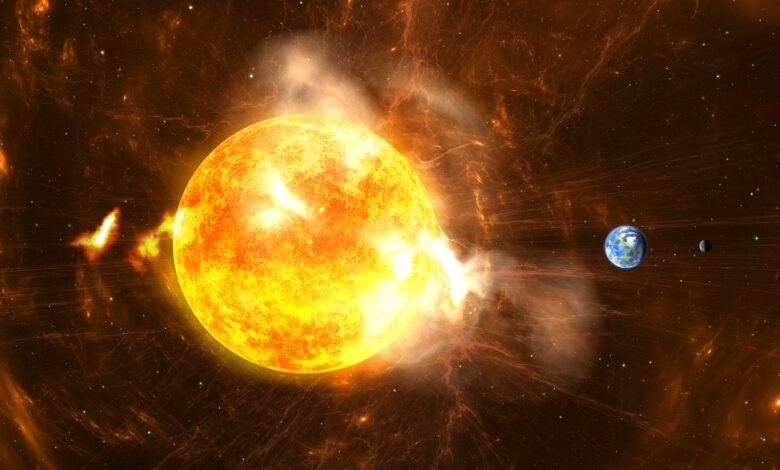
After analyzing data from half a million stars, scientists found conclusive evidence that planets disappear as their stars age, which raises a fateful question: Is this the fate that awaits our planet when our sun grows older?
Our Sun is almost halfway through its lifespan, which is also true for planet Earth. When stars exhaust their nuclear hydrogen fuel, their diameter swells than a hundredfold, swallowing up any planets in close orbits.
Although this fate will not befall our solar system for at least five billion years, scientists have recently been able to observe a scene that may be a harbinger of the fate of our world.
An international research team relied on data from the TESS satellite, which specializes in observing exoplanets, and made a comprehensive comparison between star systems that are still in the “basic sequence” stage (where hydrogen atoms fuse, as in our current sun) and those that have reached an advanced stage of life after exhausting their fuel. The study reached a clear conclusion: the older the star, the fewer planets orbiting it. In other words, planets gradually disappear as their host stars age.
This disappearance is not due to the fact that these planets were not formed in the first place, but rather to destructive processes that occur during the late stages of the star’s life. In addition to the possibility of direct engulfment as the star turns into a red giant, the increased tidal forces resulting from the star’s inflation gradually erode the orbits of nearby planets, which could lead to them being stripped of their atmospheres or even completely ripped apart.
The study was based on analyzing data about half a million stars in their late stages, of which 130 planets and planetary candidates were identified in close orbits.
The results showed a noticeable decrease in the proportion of stars hosting nearby planets as stars age, which is fully consistent with theoretical predictions about the increasing influence of tidal forces during these evolutionary stages.
This research faces special technical challenges, as most of the planets that can be monitored currently are giant planets and close to their stars, unlike our solar system. Also, observing planets around giant stars becomes difficult due to the small signal resulting from crossing in front of a large star. However, the importance of this study stems from the fact that stars with a mass similar to that of the Sun go through the same evolutionary stages, giving us a unique opportunity to anticipate the fate of our distant solar system.
An expert in the field of astronomy who did not participate in the research commented that this study represents an important step in understanding the complex interaction between planets and their host stars during the stellar life cycle, noting that the large sample analyzed allowed for the first time to clearly prove this phenomenon statistically.
Scientists hope that future space missions, such as the “Plateau” mission scheduled to be launched in 2026, will contribute to improving the accuracy of these results by providing sensitive data on the chemical properties of stars and planetary masses. These technical developments may also enable us in the future to monitor subtle orbital changes of planets that are approaching their inevitable end.
Although the inevitable fate of the Earth by fire seems far away in time, this study represents a milestone in our understanding of the fateful relationship between the planets and their stars, and opens a new window on the dramatic cosmic scene that awaits our solar system in the depths of the distant future.
Source: Space
Disclaimer: This news article has been republished exactly as it appeared on its original source, without any modification. We do not take any responsibility for its content, which remains solely the responsibility of the original publisher.
Disclaimer: This news article has been republished exactly as it appeared on its original source, without any modification.
We do not take any responsibility for its content, which remains solely the responsibility of the original publisher.
Author: uaetodaynews
Published on: 2025-12-23 16:15:00
Source: uaetodaynews.com