

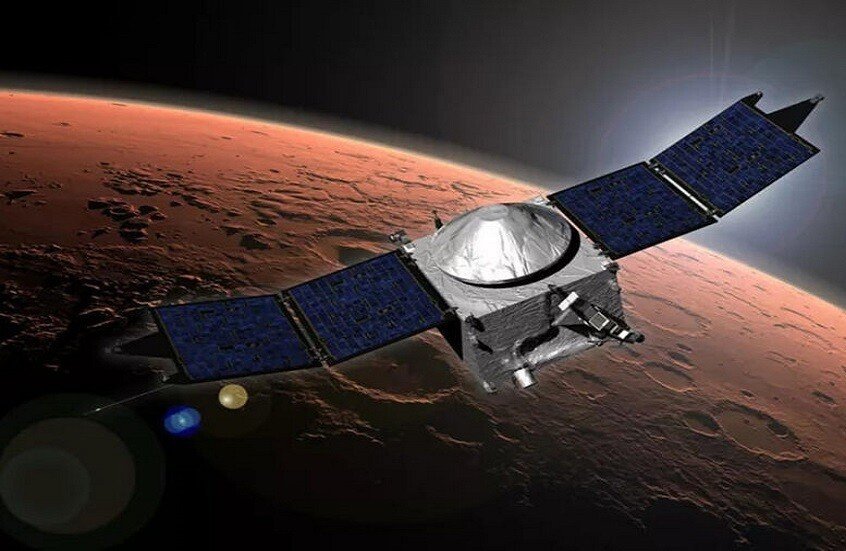
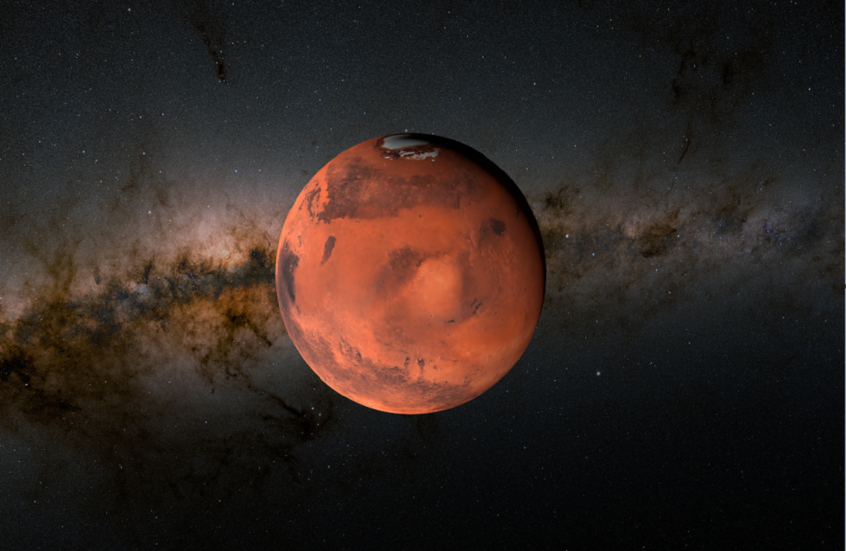
The MAVEN probe, which has been orbiting Mars since 2014 and is a vital communication link for rovers on the surface of the red planet, was tracking this interstellar visitor, which NASA classifies as a comet, when it suddenly disappeared behind Mars.
🚨: NASA’s MAVEN Spacecraft lost contact with Earth after Close-Encounter with 3I/ATLAS raising new questions as the interstellar approaches Earthpic.twitter.com/fdlGkFgJeT
— All day Astronomy (@forallcurious)“>▶ عرض المحتوى المضمّن
When it was supposed to reappear within Earth’s communication range, it was observed that it stopped transmitting and began to rotate in an abnormal way, and its orbit around the Red Planet changed, which are signs that indicate a major abnormality.
NASA teams are currently working hard to analyze the limited data to understand what happened, as the agency does not have accurate information about how the orbit changed until after communication was restored.
This malfunction comes after MAVEN had taken in October a group of pictures of the mysterious object as it passed 18 million miles from Mars. Pictures were widely criticized for their poor quality and lack of clarity, which sparked a wave of doubts and many questions.
Although NASA confirms that there is no link between the probe’s problem and the passage of the mysterious object, the incident has unleashed exciting theories on social media, especially with the approaching date of 3I/ATLAS passing its closest point to Earth on December 19.
Users of platforms such as “X” accused the agency of either hiding the real images of the object in order to know its reality, or that the object itself, if it was a spacecraft, was the one that deliberately disabled the probe.
In the midst of this controversy, Professor Avi Loeb, a prominent physicist from Harvard University, highlights a crucial point. As the object approaches Earth at a distance of 170 million miles on December 19, a date that also coincides with a “new moon” that guarantees ideal darkness for observation, hundreds of observatories and amateurs around the world will be able to monitor and photograph it, making any attempt to cover up its image “practically impossible.”
Loeb, who heads the Galileo Project to search for extraterrestrial life, confirms that this global monitoring will enable scientists to verify whether the body has a gaseous tail like natural comets, or whether what is seen as emissions is actually exhaust from the engines propelling it. He believes that 3I/ATLAS carries than ten simultaneous “anomalies” that make it very difficult to consider it an ordinary comet, the most prominent of which is a tail that heads in the opposite direction of the sun, a rare phenomenon known as an anti-tail, and resembles the exhaust of an engine that controls the body’s path.
In the face of this speculation, both NASA and the European Space Agency continue to emphasize their scientific explanation that the object is a comet coming from a distant solar system, consisting of a unique chemical mixture. However, the mystery of MAVEN’s strangely timed loss of contact remains, along with the blurry images and unfamiliar characteristics of the mysterious object, fueling new chapters in a broader scientific and popular debate about what deep space has in store for us.
Source: Daily Mail
Disclaimer: This news article has been republished exactly as it appeared on its original source, without any modification. We do not take any responsibility for its content, which remains solely the responsibility of the original publisher.
Disclaimer: This news article has been republished exactly as it appeared on its original source, without any modification. We do not take any responsibility for its content, which remains solely the responsibility of the original publisher.
Author: uaetodaynews
Published on: 2025-12-17 11:20:00
Source: uaetodaynews.com