
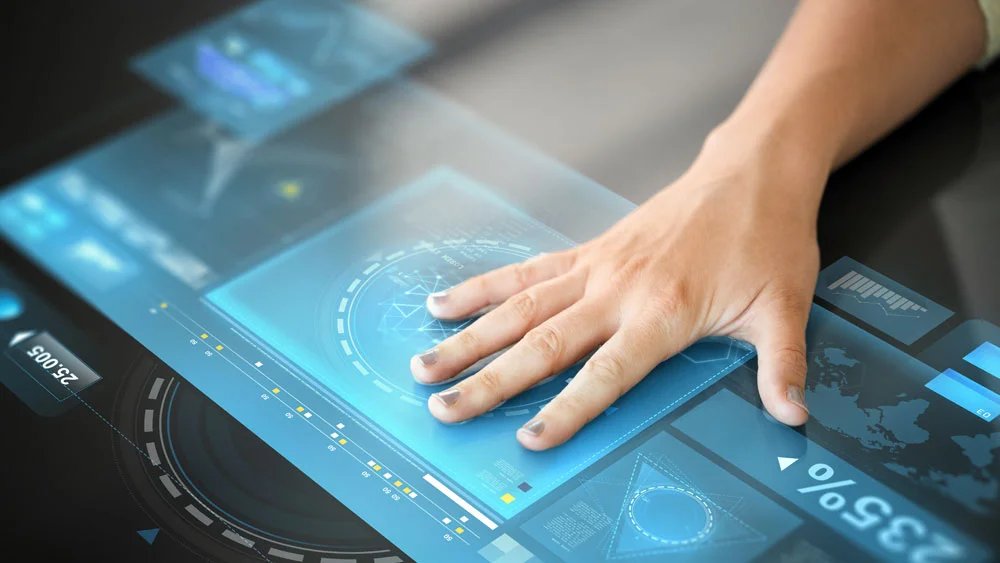
The idea for a screen with a tangible image came from the head of the RE Touch laboratory at UCSB, John Visell. He assigned this challenging task to graduate student Max Linnander when he joined the team in 2021.
“The question was quite simple: Is it possible to transform the light that forms an image into something tangible?” — said Linnander.
“We didn’t know if the idea was feasible,” Wisell added. “But the very possibility of it being impossible—and the idea of allowing people to ‘feel the light’—made the task interesting.”
From idea to implementation
It took almost a year to test the hypothesis: we worked on the theoretical basis and carried out computer modeling. Once they had a viable concept, the researchers began building prototypes.
Months passed without any results. Finally, in December 2022, Linnander invited Visell into the laboratory.
“I’ve been working on this for a year. I had to leave for the airport in a few hours; I had just launched another prototype,” he recalls.
He showed Wisell a simple but working design—a single pixel activated by short bursts of light from a small laser diode, without any additional electronics.
“I put my finger on the pixel and clearly felt a tactile impulse with each flash of light,” says Wisell. — It was a special moment. We realized that the key idea worked.”
The development is described in the magazine Science Robotics. It is based on thin display surfaces with an array ofmillimeter optotactile pixels. Each of them is individually controlled by a low-power laser – so-called optical addressing.
The same light source powers the pixels, which contain an air-filled cavity and a thin suspended graphite film. The graphite heats up under the beam, the air bubble expands, and the pixel swells by a millimeter – enough to be touched with a finger.
See and touch at the same time
The process occurs so quickly that sequential laser scanning of multiple pixels allows the creation of dynamic graphics – contours, moving figures, symbols – that can be simultaneously seen and felt. The refresh rate is high enough to make animations feel smooth, both visually and tactilely.
Because light serves as both illumination and energy transfer, display surfaces do not require built-in wiring or electronics. Instead, a small scanning laser sweeps quickly across the surface, illuminating each pixel for a fraction of a second.
The technology is scalable: the team has already demonstrated devices with than 1,500 independently controllable pixels—significantly superior to existing haptic displays, Linnander boasts. Much larger formats are also possible, including using modern laser video projectors.
Tested on people
The researchers also examined user perceptions when interacting with the displays. Participants were able to pinpoint the location of individual illuminated pixels by touch with millimeter precision, confidently recognize moving images, and easily discern spatial and temporal patterns.
Thus, the experiments convincingly confirmed that the system is capable of reproducing a wide range of tactile sensations.
Such visual-tactile displays can find application in a variety of areas. Visell envisions the technology making it possible to create automotive touchscreens that mimic physical controls, e-readers with illustrations that come to life on the page that you can touch, and architectural surfaces for mixed reality that blur the boundaries between the digital and physical worlds.
Whatever the future holds for this development, it is based on a simple and fascinating idea:everything we see can be felt.
Disclaimer: This news article has been republished exactly as it appeared on its original source, without any modification.
We do not take any responsibility for its content, which remains solely the responsibility of the original publisher.
Disclaimer: This news article has been republished exactly as it appeared on its original source, without any modification.
We do not take any responsibility for its content, which remains solely the responsibility of the original publisher.
Author: uaetodaynews
Published on: 2025-12-06 16:12:00
Source: uaetodaynews.com