One Of “Publishing’s Greatest Failures” – How A 500
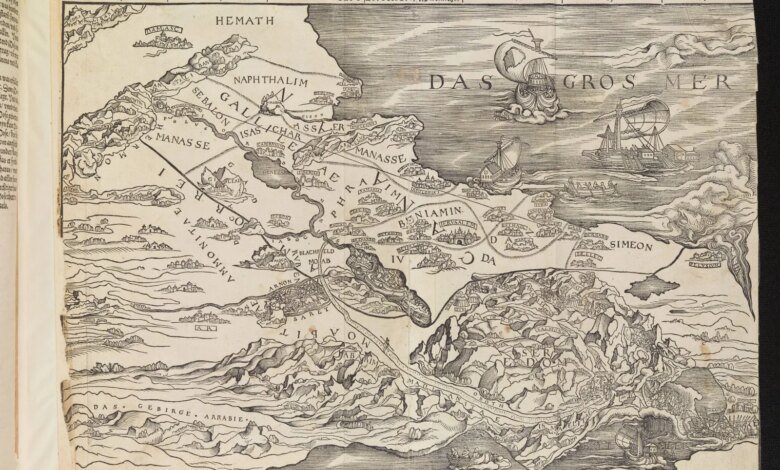
A new Cambridge study reveals how the first Bible ever printed with a map, released in 1525 with the Holy Land accidentally reversed, ended up transforming far than biblical illustration.
The first Bible to include a map of the Holy Land was published in 1525, marking its 500th anniversary this year. Although the map was printed the wrong way round – the Mediterranean was placed to the East – its presence set a new standard that, according to a recent Cambridge study, still influences how modern borders are imagined.
“This is simultaneously one of publishing’s greatest failures and triumphs,” says Nathan MacDonald, Professor of the Interpretation of the Old Testament at the University of Cambridge.
“They printed the map backwards so the Mediterranean appears to the east of Palestine. People in Europe knew so little about this part of the world that no one in the workshop seems to have realized. But this map transformed the Bible forever, and today most Bibles contain maps.”
the و of و to – تفاصيل مهمة
In research published inThe Journal of Theological StudiesProfessor MacDonald explains that Lucas Cranach the Elder’s map, produced in Zürich, not only turned the Bible into a work aligned with the Renaissance but also influenced emerging ideas about territorial organization.
“It has been wrongly assumed that biblical maps followed an early modern instinct to create maps with clearly marked territorial divisions,” MacDonald says. “Actually, it was these maps of the Holy Land that led the revolution.
“As and people gained access to Bibles from the 17th century, these maps spread a sense of how the world ought to be organised and what their place within it was. This continues to be extremely influential.”
The first ‘Bible map’
Only a handful of copies of Christopher Froschauer’s 1525 Old Testament still exist in libraries worldwide. One of these rare editions is preserved at Trinity College Cambridge’s Wren Library.
of و maps و to – تفاصيل مهمة
Inside this volume, Cranach’s map illustrates both the key locations associated with the wilderness wanderings and the division of the Promised Land into twelve tribal regions. These borders reflected a specifically Christian interest in asserting a historical claim to the sacred sites connected to the Old and New Testaments.
Cranach drew on earlier medieval mapping traditions that depicted Israel as a series of neatly separated land strips, a style influenced by the 1st century AD Jewish historian Josephus, who attempted to harmonize the Bible’s often inconsistent geographical accounts.
According to MacDonald, “Joshua 13–19 doesn’t offer an entirely coherent, consistent picture of what land and cities were occupied by the different tribes. There are several discrepancies. The map helped readers to make sense of things even if it wasn’t geographically accurate.”
A literal reading of the Bible was particularly central to the Swiss Reformation and so, MacDonald says: “It’s no surprise that the first Bible map was published in Zürich.”
the و of و to – تفاصيل مهمة
MacDonald, a Fellow of St John’s College Cambridge, argues that with a growing emphasis on the literal reading of the Bible, maps helped to demonstrate that events took place in recognizable time and space.
In a Reformation world in which certain images were banned, maps of the Holy Land were permitted and became an alternative source of pious reverence.
“When they cast their eyes over Cranach’s map, pausing at Mount Carmel, Nazareth, the River Jordan and Jericho, people were taken on a virtual pilgrimage,” MacDonald says. “In their mind’s eye, they travelled across the map, encountering the sacred story as they did so.”
The inclusion of Cranach’s map was, MacDonald argues, a pivotal moment in the Bible’s transformation, and deserves greater recognition. Better known changes include the move from scroll to codex, the creation of the first portable single-volume Bible (The Paris Bible) in the 13thCentury; the addition of chapters and verses; the addition of new prefaces in the Reformation; and the recognition of the prophetic utterances as Hebrew poetry in the 18th Century.
the و of و in – تفاصيل مهمة
“The Bible has never been an unchanging book,” MacDonald says. “It is constantly transforming”.
A revolution in the meaning of borders
In medieval maps, MacDonald argues, the division of the Holy Land into tribal territories had communicated spiritual meaning: the inheritance of all things by Christians. But from the late fifteenth century, lines spread from maps of the Holy Land to maps of the modern world, and began to represent something very different: political borders. At the same time, these new ideas about political sovereignty were read back into biblical texts.
“Bible maps delineating the territories of the twelve tribes were powerful agents in the development and spread of these ideas,” MacDonald says. “A text that is not about political boundaries in a modern sense became an instance of God’s ordering of the world according to nation-states.”
“Lines on maps started to symbolize the limits of political sovereignties rather than the boundless divine promises. This transformed the way that the Bible’s descriptions of geographical space were understood.”
the و of و maps – تفاصيل مهمة
“Early modern notions of the nation were influenced by the Bible, but the interpretation of the sacred text was itself shaped by new political theories that emerged in the early modern period. The Bible was both the agent of change, and its object.”
Relevance today
“For many people, the Bible remains an important guide to their basic beliefs about nation states and borders,” MacDonald says. “They regard these ideas as biblically authorized and therefore true and right in a fundamental way.”
MacDonald points to a recentUS Customs and Border Protection recruitment filmin which a border agent quotes Isaiah 6:8 – ‘Then I heard the voice of the Lord saying, “Whom shall I send? And who will go for us?”’ – while flying above the US-Mexico border in a helicopter.
Professor MacDonald is concerned that so many people view borders as being straightforwardly biblical. “When I asked ChatGPT and Google Gemini whether borders are biblical, they both simply answered ‘yes’. The reality is complex,” he says.
and و the و a – تفاصيل مهمة
“We should be concerned when any group claims that their way of organizing society has a divine or religious underpinning because these often simplify and misrepresent ancient texts that are making different kinds of ideological claims in very different political contexts.”
Reference: “Ancient Israel and the Modern Bounded State” by Nathan MacDonald, 29 November 2025,The Journal of Theological Studies.
DOI: 10.1093/jts/flaf090
Never miss a breakthrough: Join the SciTechDaily newsletter.
Follow us on Google and Google News.
Disclaimer: This news article has been republished exactly as it appeared on its original source, without any modification. We do not take any responsibility for its content, which remains solely the responsibility of the original publisher.
Author:University of Cambridge
Published on:2025-12-03 19:07:00
Source: scitechdaily.com
Disclaimer: This news article has been republished exactly as it appeared on its original source, without any modification.
We do not take any responsibility for its content, which remains solely the responsibility of the original publisher.
Author: uaetodaynews
Published on: 2025-12-03 15:45:00
Source: uaetodaynews.com